

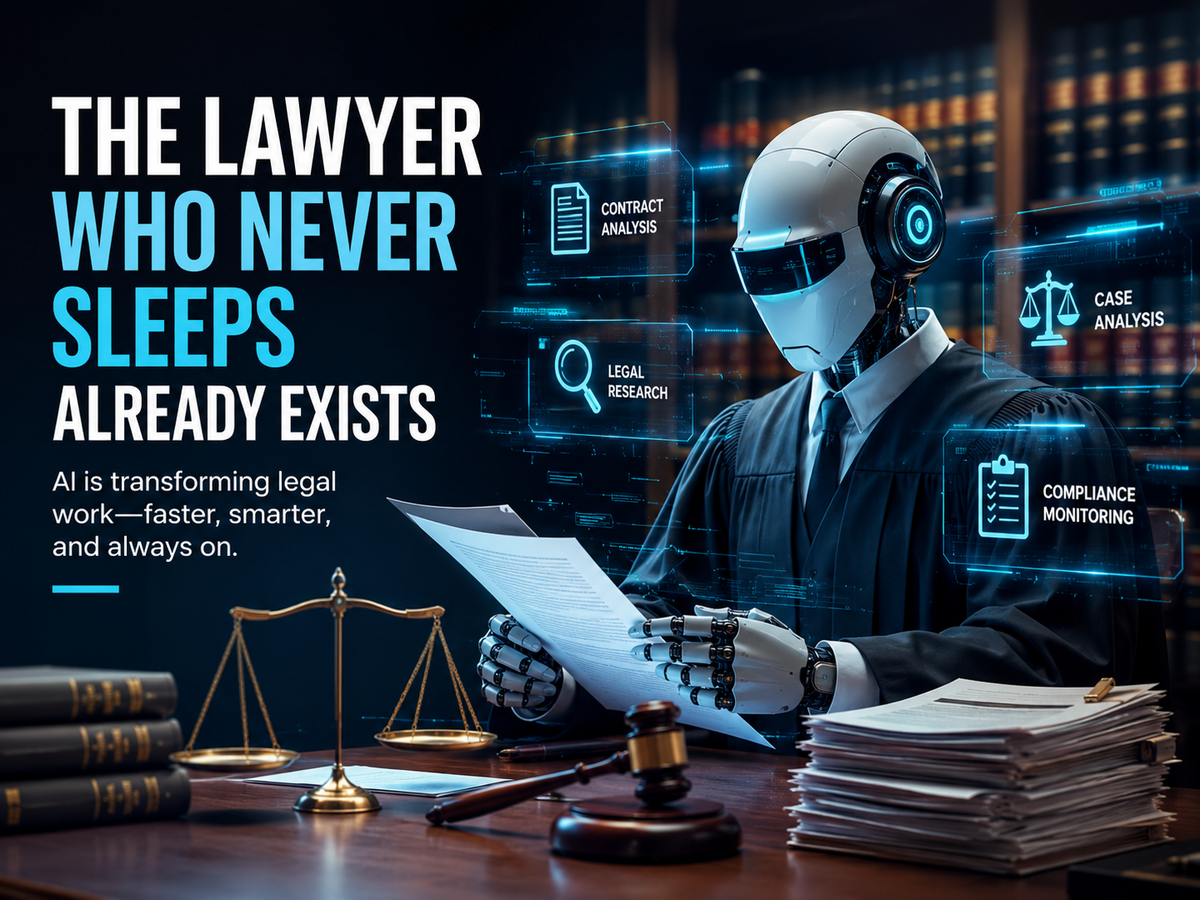
Artificial intelligence isn't replacing lawyers overnight but it is quietly transforming what legal work looks like, one task at a time.
The legal profession has always been built on precision, precedent, and painstaking attention to detail. For decades, legal teams accepted that reviewing thousands of contracts, researching case law, or ensuring regulatory compliance simply required long hours and even longer nights. That assumption is beginning to change.
Today, a new kind of legal professional has entered the workplace. It doesn't hold a law degree, it never asks for a vacation, and it works every hour of every day. Artificial intelligence has become the "lawyer who never sleeps," reshaping legal operations across law firms, corporate legal departments, and regulatory teams around the world.
Unlike previous waves of legal technology that focused primarily on digitizing paperwork, modern AI is taking on analytical responsibilities that were once considered exclusively human. The shift is no longer about replacing paper with software—it's about transforming how legal work gets done.
AI Is Quietly Becoming the Legal Team's Fastest Associate
Legal AI has matured far beyond simple document management systems. Today's platforms can review contracts, summarize lengthy legal documents, identify unusual clauses, compare agreements against internal policies, and surface compliance risks in minutes rather than days.
For businesses managing hundreds or thousands of agreements each year, that difference isn't merely about saving time. Faster legal reviews accelerate sales cycles, reduce operational bottlenecks, and help organizations respond more quickly to changing regulations.
Rather than replacing legal professionals, AI is increasingly functioning like an exceptionally fast junior associate—handling repetitive research and document-heavy work while experienced lawyers focus on strategic decision-making, negotiation, and client counsel.
The Legal Profession Is Redefining Productivity
One of the biggest misconceptions surrounding AI is that productivity simply means doing existing work faster. In reality, legal teams are beginning to redefine what productivity actually looks like.
Instead of spending hours searching through contracts, lawyers can dedicate more attention to advising leadership, anticipating risks, and developing stronger legal strategies. This transition represents one of the most significant shifts the legal industry has experienced since digital legal databases replaced physical law libraries.
The competitive advantage is no longer measured solely by billable hours. Increasingly, it is measured by how effectively firms combine human expertise with intelligent automation.
Why Corporate Legal Departments Are Leading the Change
Large enterprises often manage contracts across procurement, human resources, finance, cybersecurity, vendor management, and customer operations simultaneously. Every agreement introduces obligations that require careful monitoring throughout its lifecycle.
AI-powered legal platforms are helping corporate legal departments monitor these responsibilities continuously instead of reviewing them only during scheduled audits. As regulations evolve across data privacy, cybersecurity, ESG reporting, and international trade, automated monitoring provides businesses with greater visibility into emerging compliance risks.
This proactive approach enables organizations to identify potential issues before they become expensive legal disputes.
Compliance Is Becoming Continuous
Traditionally, compliance has followed a periodic rhythm. Policies would be reviewed quarterly, annually, or when new regulations appeared. That model is becoming increasingly difficult to sustain as governments introduce faster-moving digital regulations.
AI enables organizations to monitor contracts, internal policies, and regulatory updates in near real time. Rather than reacting after a compliance issue emerges, businesses can identify inconsistencies much earlier.
For industries operating under complex regulatory environments, including healthcare, banking, insurance, and technology—continuous compliance is quickly becoming a strategic capability rather than a regulatory requirement.
Human Judgment Still Defines the Law
Despite rapid advances, AI has clear limitations.
Legal practice extends far beyond identifying clauses or summarizing documents. Lawyers negotiate settlements, evaluate business context, interpret ambiguous regulations, build courtroom arguments, and understand the human dynamics behind every dispute.
These responsibilities require ethical judgment, emotional intelligence, negotiation skills, and professional accountability—qualities that remain uniquely human.
Instead of replacing attorneys, AI is shifting their role toward higher-value work where experience and reasoning matter most.
The New Competitive Advantage
The legal organizations gaining momentum are not necessarily those investing in the most AI software. They are the ones redesigning their workflows around collaboration between lawyers and intelligent systems.
Forward-thinking firms are integrating AI into contract lifecycle management, litigation preparation, due diligence, legal research, compliance monitoring, and knowledge management. The result is a legal function that becomes faster, more scalable, and increasingly strategic.
Clients are beginning to expect this level of efficiency as standard rather than exceptional.
Looking Ahead
The phrase "the lawyer who never sleeps" may sound futuristic, but the reality has already arrived. AI is now reviewing contracts while businesses sleep, tracking regulatory changes across jurisdictions, identifying risks before they escalate, and helping legal teams deliver faster insights than ever before.
The profession itself is not disappearing. Instead, it is evolving into something more strategic.
History suggests that technology rarely replaces entire professions. It changes what professionals spend their time doing. For lawyers, that transformation is already underway. The firms that embrace AI as a collaborative partner—rather than viewing it as a competitor are likely to define the next chapter of legal services.
The legal profession's future may not belong to those who work the longest hours. It may belong to those who know when to let the lawyer who never sleeps handle the routine work, allowing human expertise to focus on the decisions that truly shape justice and business alike.